By Kelefa Sanneh | Photography by Luis Alberto Rodriguez | Styled by Carlos Nazario
For over a decade, Michael B. Jordan has been talking about taking a break. Back in 2015, he was a young man, 28, with lots of screen credits and one main goal: make the transition from working actor to working movie star. That year, Jordan starred in a little-loved superhero movie, Fantastic Four, and then a much-loved boxing movie, Creed, a sequel to the fifth sequel of Rocky, which became a franchise in its own right thanks in large part to Jordan’s performance. He said that he wanted to ride his hot streak as long as it lasted—long enough, he hoped, to make some money to take care of his parents and his siblings. “Once they’re good I can start living a little,” he said. “My mid-30s I can live a little.” By the time he starred in Just Mercy, a 2019 legal drama based on the life of a civil rights lawyer, he was 32, with a place on Hollywood’s A-list, and he was still thinking about his next phase. He told an interviewer that he would be “in work mode” for the next few years, after which he might slow down for a while.
It has been seven years since he made that prediction, and he is busier than ever. In Hollywood, there is one credential that even movie stars covet, and Jordan received it this past March, when he was named best actor at the Academy Awards, in recognition of his dual performances as a pair of enterprising brothers in Sinners. When I caught up with him a few months later, in London, the next 12 months were already spoken for. He was scrambling to finish his new film, a reimagination of The Thomas Crown Affair, for which he is doing triple duty as actor, producer, and director. In the fall he would be shooting what could be his next lucrative franchise, a reboot of Miami Vice costarring Austin Butler, and producing Delphi, a Creed series spin-off set in a boxing gym. All spring, he’ll be promoting Thomas Crown, and after that? “I’ll probably take the rest of next year off,” he told me. “That’s probably when I’m going to do more reflecting and processing of all of this. Because honestly, it’s been—I’ve been moving.”
One of Jordan’s great gifts as an actor is his seriousness: As a teenager, he played characters that seemed wise beyond their years, like Wallace in The Wire, a fledgling drug dealer who seemed to understand the tragic nature of the drug trade better than the older guys who were showing him the ropes. Jordan has occasionally poked fun at his own reputation for earnest confidence. A few years ago, when he was the host of Saturday Night Live, he said during his monologue, “Sometimes, I can take myself a little too seriously.” But in person, he can be surprisingly boyish. He is now 39, enthusiastic and absurdly fit—and, it seems, relatively unjaded. As a boy, he used to sneak into the basement of his church in Newark, New Jersey, to catch episodes of Dragon Ball Z on television, and he remains an anime obsessive, with some projects in early stages of development. “I might just quit it all and make anime the rest of my life,” he told me, maybe only half joking.
Jordan has spent much of the past year in London, where his home is a suitably grand hotel, and that’s where he could be found on a recent afternoon. He was dressed comfortably but meticulously in pleated Issey Miyake trousers, a Nepenthes London cardigan, and spotless high-top Chuck Taylors by Fear of God. He told me that his life in London was pretty circumscribed—he spends most days in the hotel suite that serves as his makeshift office, or on set, or traveling between the two. But he has been surprised to find that when you are an American abroad—especially a Black American, perhaps—locals often express concern. He said, “People are like, ‘Oh, you’re from America, are you okay?’ ” This probably reflects Europe’s view of American politics, but maybe it also reflects the fact that something about Jordan makes people want to root for him, even when he seems to be on top of the world.
Thomas Crown was mainly filmed last year, but Jordan reunited the cast this summer for some reshoots, and on the day I first met him he was still scrutinizing storyboards and shot lists, figuring out what would fit into the eight days he had scheduled. Jordan’s emergence as a director has been methodical and pragmatic. He made his directorial debut with 2023’s Creed III—partly, he said, because he wanted more creative control, but also because neither Ryan Coogler, who directed the first one, nor Steven Caple Jr., who directed the second one, were available. Thomas Crown is, likewise, a relatively safe bet: a remake of the beloved 1999 art-heist movie, which starred Pierce Brosnan and Rene Russo, and which was itself a remake of the 1968 original, which paired Steve McQueen with Faye Dunaway. Jordan’s version was originally supposed to costar the Canadian actor Taylor Russell, but she left the production last summer, reportedly due to creative differences, and was replaced by Adria Arjona, best known for her role in Andor, the Star Wars spin-off. Jordan wouldn’t say much about the change, or about his vision for the film, though he hinted that he was nudging the titular character in a new direction. In the older films, Thomas Crown was a rich, rakish thief who saw grand larceny as a high-stakes game, but Jordan’s version of him is no mere playboy. “I don’t think a billionaire, or a millionaire, just doing shit for fun, right now, is something that people want to see,” he told me. Instead, he said, his Crown is a mission-driven protagonist: a guy with a reason to do whatever he does, though possibly not a good one.
Jordan said he didn’t find it helpful to think of himself as a movie star—the term he used instead was leading man, which is a factual description of his place on call sheets and posters. He had shed a little muscle to play Thomas Crown, although it seems clear that his Crown could beat up the two previous ones, perhaps simultaneously. At one point I asked him to imagine what might have happened if he had never graduated to movie stardom—could he have been satisfied with life as a working actor? It seemed like a simple question, but he paused for a long time and then laughed, shaking his head, and said quietly, “I don’t know. My competitiveness—I don’t know.” He talked about his years on television, and about the inspiration he drew from Denzel Washington, and eventually he landed upon an answer. Michael B. Jordan, character actor? “I don’t think so. Whatever I wanted to do in life, I wanted to be competitive at, and I wanted to be mentioned amongst the greats.”
Contemporary movie stars, especially men, are often expected to be jokey and self-deprecating, but Jordan takes a more old-fashioned approach: smile, work hard, be polite, stay focused. And his reward, so far, has been the kind of broad unproblematic popularity that has almost entirely eluded fellow actors of his generation. Kenneth Branagh, who costars in Thomas Crown, remembers meeting Jordan to discuss his role and being impressed. “He seemed pretty serious about his work, but also quite twinkly,” Branagh told me. “Mischievous, rather cheeky, rather playful.” Ben Affleck, who has become a close friend and mentor to Jordan, told me that he was impressed by Jordan’s discipline and maturity and by his ability to embody a range of male archetypes. “He’s kind of like a Cary Grant, but more physically imposing and masculine,” Affleck told me. “He can go across all these different genres: totally credible as a fighter, totally credible as somebody who’s vulnerable, totally credible also as an extremely intelligent person. I always see his movies and go, That’s the real him. No, that’s the real him!”
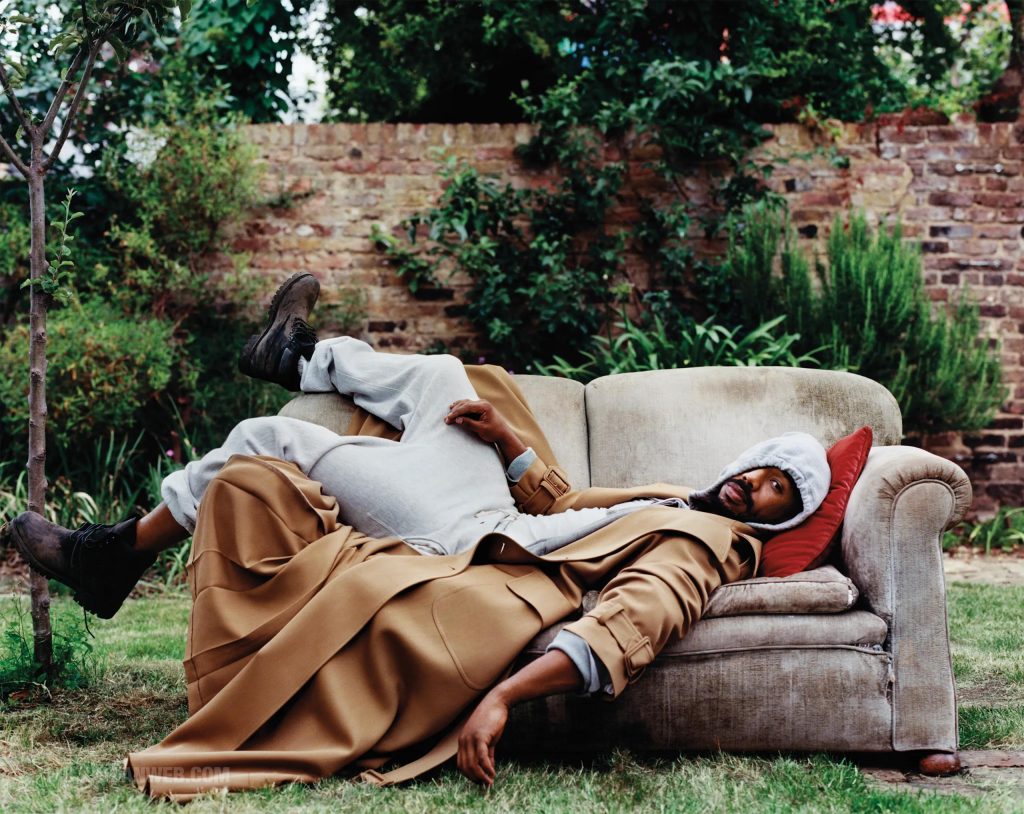
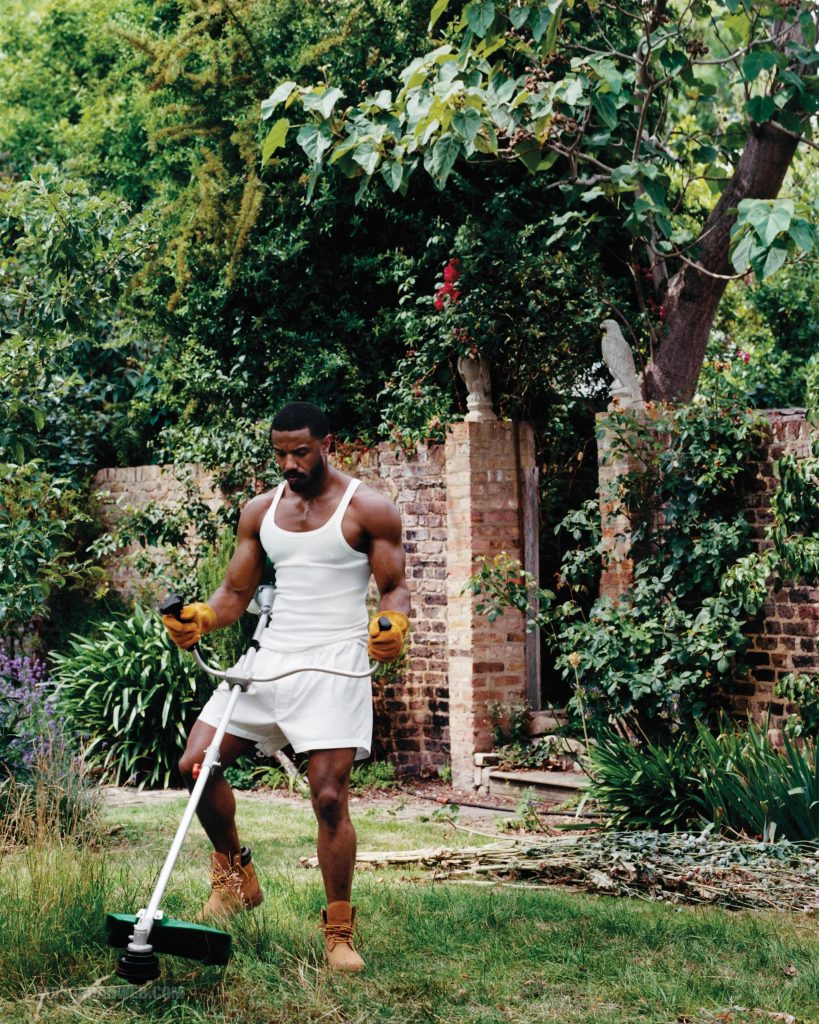
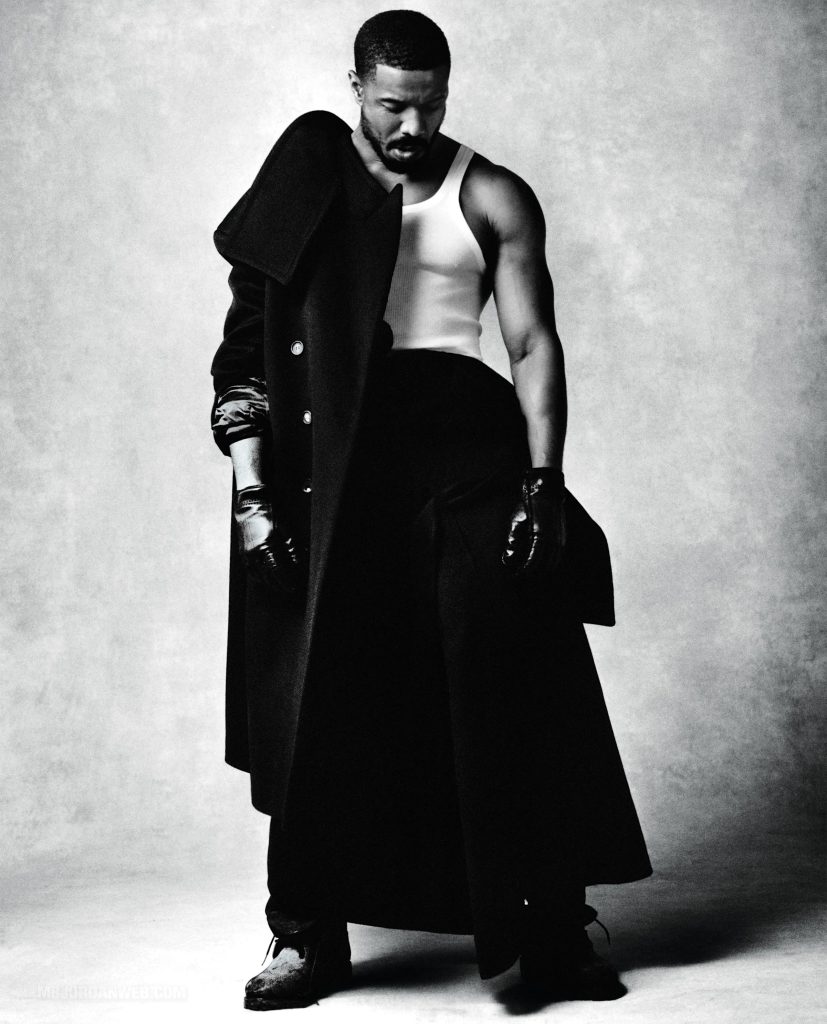
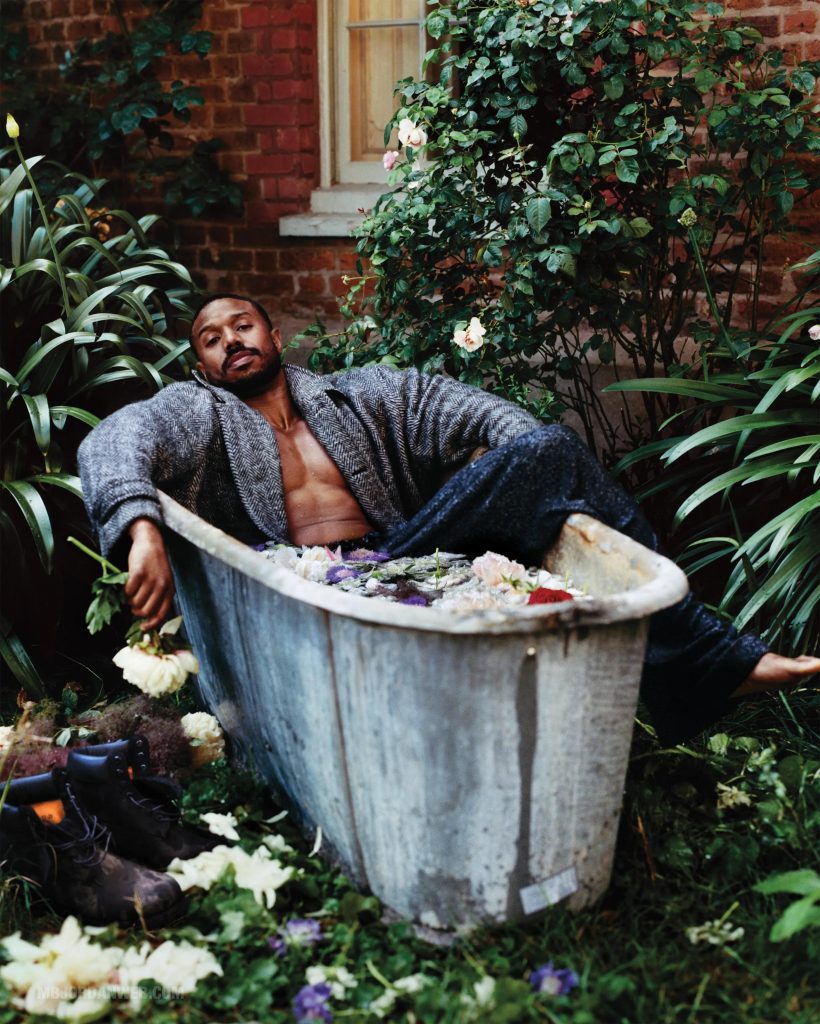
To finish Thomas Crown, Jordan and his production team had temporarily taken over a warren of offices in a film studio outside of London. He arrived one morning, a bit later than usual, with his voice slightly hoarse, and an observer might have imagined that he was recovering from a long night out. In fact, he was recovering from his Vogue shoot, which had taken place the previous day in a picturesque garden full of plants and flowers—and, apparently, allergens. Not that he was complaining. He was excited about the shoot and what it represented. “A Black man on the cover of American Vogue,” he said. “Black stylist, Latino photographer.” Even better, the shoot had given him a chance to play gardener, wielding a string trimmer—his everyday life does not provide many opportunities for yard work. Jordan retreated into his corner office, put on some R&B, and huddled with some of his crew members to figure out the blocking for an upcoming scene. The details of the film are strictly embargoed, but I can reveal that at some point Thomas Crown jumps from something and lands somewhere, and Jordan was trying to figure out whether he should land on his feet, or else fall, roll, and then get up. Jordan is scrupulous about action scenes. As Adonis Creed, in the Creed films, he tried to make sure that every punch was like a line of dialogue, with its own narrative meaning. And on Thomas Crown, Branagh was struck by Jordan’s obsession with movement. Branagh says that Jordan reminded him of another great performer he had briefly worked with: Mikhail Baryshnikov, the dancer turned actor, who appeared alongside Branagh in one of the Jack Ryan films. “He is someone who has a very sharp mind,” said Branagh of Jordan, “but he thinks physically.”
By his own account, Jordan started acting long before he had any real idea what he was doing. He was raised in a loving but money-conscious household in Newark; his mother was a social worker, and for a time his father was a supervisor at JFK Airport, in New York. When he was born, in 1987, a guy with the same name was already emerging as an all-time great, and Jordan sometimes talks about this fact as a motivating force: He had to figure out how to withstand inevitable comparisons to one of the most famous athletes on the planet. (Nowadays, one of the few people better known than Michael B. Jordan is the man who shares his name.) Jordan’s career began when a receptionist at a doctor’s office told his mother that her son might be able to earn the family some money by working as a model. Soon he began to land small acting roles, learning on the job. He played a member of a kids’ baseball team in Hardball, a 2001 Keanu Reeves movie; Jordan was 14 when it was released, and he remembers riding the bus with his friends to watch it at a nearby mall, looking around at fellow audience members to see if anyone would recognize him. (No one did.) In The Wire, Jordan had to work even harder: A scene called for his character, Wallace, deep in the drug trade and suffering with guilt, to try heroin for the first time. Jordan sought advice from his castmate Andre Royo, who portrayed a charismatic drug user known as Bubbles. “He was eager to learn and wanted to understand,” Royo said. Royo told Jordan what it might feel like to get high for the first time and how to credibly portray that onscreen. “It was the first moment that I didn’t feel like me, and I lost myself in the character,” Jordan said. “I’ve been chasing the ability to get into those moments ever since.”
It’s hard to know how Jordan’s career would have unfolded if he hadn’t crossed paths with Ryan Coogler, a first-time director from Oakland who was casting a film about Oscar Grant, a young man who had been shot and killed by police in a local subway station. Coogler had admired Jordan’s television work, and was surprised to hear that he had never had a lead role. “I thought that was kind of preposterous,” Coogler said. The film, Fruitvale Station, was a surprise hit in 2013, and in its aftermath the director and the star did something nearly unprecedented in Hollywood: They stuck together. “I’d run through a brick wall for Coog—literally, from day one,” Jordan said in an interview a few years ago.
Coogler asked Jordan to play Adonis Creed before Fruitvale Station was finished, even though Jordan had never boxed before. He cast Jordan as Killmonger, the charismatic antagonist in Black Panther, which looks in retrospect like the peak of the superhero era. In 2024 they reunited for Sinners, their riskiest project so far: a supernatural, music-inspired historical drama, with an original screenplay by Coogler, who decided that instead of selling the film he would lease it, for 25 years, to Warner Bros., after which the rights would revert to him. Sinners was a smart gamble, for both Coogler and Warner. It earned $48 million domestically on its opening weekend and has since grossed more than $370 million worldwide. Jordan played Smoke and Stack, two brothers with similar life stories but different attitudes and trajectories. No doubt some viewers were at least as interested in the trajectory of Jordan’s wardrobe, which evolved from wool three-piece suits at the beginning of the film to a blood-stained tank top, which effectively showed off Jordan’s rippling arms, near the end. This, of course, is part of the secret to Jordan’s success: People love looking at him. He once told Oprah Winfrey that he had gotten by largely on “youth and pure energy.” She suggested an additional asset. “And your dimples,” she said, chuckling. “Dimples are working for ya.”
arlier in his career, Jordan said that he wanted to be careful not to play too many characters who wound up dead, although he couldn’t always afford to be picky. Wallace, on The Wire, does not survive the first season. And in many of Jordan’s formative roles, he played characters entangled with street crime. He spent three years on All My Children playing Reggie, a troubled teenager with a history of violence. (Jordan has described the soap opera as his version of acting school, although he once referred to Reggie as “a fucking stereotypical Black role.”) Years after The Wire, he had a two-season arc on Friday Night Lights as Vince Howard, a talented football player trying to figure out whether and how to separate himself from his gun-toting friends in the neighborhood. And of course, Fruitvale Station is built around an ancient kind of dramatic irony: We know how it will end, but Jordan’s character does not. Octavia Spencer played his mother, and, although they had only three days together on set, they instantly fell into a familial relationship, perhaps because Spencer had been watching Jordan grow up onscreen. She remains a friend of his today, as well as a fan—she told me that on a recent flight she found herself rewatching both Black Panther and Sinners and was struck by how totally he seemed to inhabit the characters. “He’s this generation’s Sidney Poitier,” she told me. “There aren’t very many Black leading men who are bona fide box office successes.”
Given the reality of Black life in America, no one would want American films to avoid stories about young Black men contending with crime and punishment, violence and death. At the same time, Black actors typically and understandably object to being typecast in these roles, even if they reflect sociological truths. This tension is probably inherent to the practice of moviemaking, which generally aims to evoke the world we live in while also allowing us to imagine a world we might prefer to live in. In 2018 Jordan announced that his production company, Outlier Society, would be using a so-called inclusion rider, which obliges studios it works with to commit to hiring diverse casts and crews. “He’s very purpose-oriented in his work,” says Tessa Thompson, who played his love interest, and then his wife, in the Creed films. “He thinks a lot about the implications of the characters he plays, and what he wants to tell folks about what’s possible—especially for Black men.” She pointed to a much-discussed scene in Creed, in which Jordan’s character helps Thompson’s character with her braids. “I think that’s something that’s really important to him: What are the things that we want to normalize, and frankly glamorize, about our everyday lives?” In the old Rocky movies, Stallone played the titular character as a mangled and wounded warrior—someone we loved and often pitied. But as Adonis Creed, Jordan was reliable, responsible, efficient: not just inspirational, but aspirational too.
Coogler recognized this quality in Jordan from the beginning of their partnership and found smart ways to play against it. As Killmonger in Black Panther, Jordan single-handedly elevated the film from a parable of good versus evil into something more ambiguous. Killmonger was both a revolutionary and a cynic, understandably embittered by the world’s injustice, and eager to remake the fictional African kingdom of Wakanda in his own image—or, perhaps, destroy it. “We’ve got to believe that he can take down all of Wakanda, that he’s capable of harming our heroes,” Coogler told me. “That’s even harder to do when you have that charisma.”
As Thomas Crown, Jordan will be a different kind of antihero, a sophisticated rogue with a taste for fine art and fast cars. As he walked around the studio lot outside London, though, Jordan examined the sets that were being built for him, trailed by dozens of crew members and collaborators, many of whom needed him to make decisions on the spot: How many extras should populate a makeshift office that was being built? Which books should appear on the bookshelf, and should their spines be legible? Should a conference-room door be clear glass or else opaque, which is slightly less realistic but significantly easier to shoot? One team was building a hallway—how wide would it need to be to accommodate the action that needed to take place within it? At one point, Jordan spied a camera operator whom he hadn’t seen in many months, and they exchanged a warm hug.
“How you feeling, bro?” the operator asked.
“I feel good, man,” Jordan said.
“You have some time to chill?”
Jordan didn’t hesitate. “No,” he said, smiling.
Jordan said his schedule has helped him not get too disoriented by the aftermath of his Oscar win, which was the culmination of a long and exhausting awards campaign. When his name was announced, he clasped his mother’s hand, stood up to share a vigorous pound hug with Coogler, and then took to the stage, frowning with concentration. He ran through his thank-yous and tried to express the overwhelming sense of obligation he felt. “I know you guys want me to do well, and I want to do that, because you guys bet on me,” he said. “Imma keep stepping up, and Imma keep being the best version of myself I can be.” The next day, he told me, he got sick. “Like, you reached the finish line, and your body said, ‘Alright, I got you here, time to shut down for a second,’ ” he said. He had a bunch of old friends in town from New Jersey, which meant that he was surrounded by revelry that he couldn’t fully participate in. “They’re ordering food, talking, laughing about the night, telling stories, just reliving it all,” he remembers. Jordan, meanwhile, spent the next four days recuperating with the assistance of an intravenous drip.
Throughout his career, Jordan has generally declined to share details about his personal life, besides the fact that he is devoted to his family. (Not long ago, his father moved to Ghana—unrelated, Jordan said, to the popularity of Black Panther and its fictional African homeland, although his father has run into plenty of Black Panther fans there.) His sole high-profile relationship was with Lori Harvey, the model and actress who is also the adopted daughter of the comedian Steve Harvey. (This summer, his fans got something new to talk about: images of Jordan at an amusement park with Raye, the British singer.) When Jordan hosted Saturday Night Live, he and Harvey had recently split, and he acknowledged that he had just been through his “very first public breakup,” which was the cue: A procession of cast members arrived to try their luck, including Punkie Johnson, who had previously described herself as a “little lesbian chick from New Orleans.” She complimented his suit, and Jordan said, “Aren’t you gay?”
“I am,” she said. “But you Michael B. Jordan, and I’m Punkie B. Curious.”
He has said that he wants to follow the lead of Denzel Washington, who has tended to disappear between films, never allowing audiences to feel they know him too well—or, more important, to get sick of him. In the first part of his career, Jordan succeeded by seeming like a relatively normal guy—a more handsome, more muscle-bound version of the affable young man that everyone knows and likes. As a director, though, he might be emerging as a somewhat quirkier character. With Creed III, he was determined to take some chances. The final fight scene was inspired by climactic confrontations common to anime: The audience falls away so that Adonis and his opponent are alone in an empty ring, or maybe suspended in space, so that their fight becomes a kind of merging. (The scene originally had voiceover narration, too, but he ultimately decided it was too big a departure from the canonical tone and style of the Rocky franchise.) And for Thomas Crown, he wants to lean into the main character’s obsession with visual art; the 1968 original, directed by Norman Jewison, pioneered a then novel split screen film technique, and Jordan likes the idea of figuring out his own visual language so that one day his films might be recognizably his, even if he’s not in them.
For now, he knows that his unrivaled personal popularity is one of his greatest directorial assets. Which is why, one evening this past June, he flew to Barcelona, where some of the world’s most influential movie-theater executives were gathered for CineEurope, an annual conference. Jordan arrived at his hotel after midnight and spent an hour or so strolling the city’s streets, unnoticed by passersby, looking for possible locations to grab some extra footage for Thomas Crown. The next day, his SUV pulled quietly into a private parking garage at the city’s convention center, where attendees thought they were about to hear a presentation about the film. Instead, Jordan himself walked onto the stage, dressed for summer in a brown tank top and linen pants, blinded by the stage lights, as thousands of movie professionals roared like true fans. “I was going to say, ‘Good to see you,’ but I can’t see anything right now,” Jordan said. He praised his predecessors, McQueen and Brosnan; and his costar, Adria Arjona; and promised that the film would give audiences “a big-screen experience.” The brief trailer lived up to the introduction—I thought I heard a murmur of appreciation when the camera lingered on Jordan’s torso, sweaty from a workout. Apparently a great art heist requires brawn as well as brains.
In fact, Jordan was orchestrating a kind of heist right there in the theater. Once the audience had been ushered into the lobby by a promise of lunch, he changed into a collared shirt—his Thomas Crown outfit. He thought he might be able to use some footage of Crown onstage, and so he and his first assistant director, H.H. Cooper, had conspired to do a quick guerrilla shoot. The next event was starting soon, but no one seemed too worried. “We got seven minutes—exactly seven minutes,” one of Jordan’s assistants said.
Cooper just shrugged. “We can do a lot in seven minutes.”
Jordan has worked hard over the past few years to expand his range and enlarge his ambit. But it was still a thrill to see him transform back into what he has been since he was a kid: an actor, with an extraordinarily instinctive sense of how to hit a mark, deliver a line, make an entrance, make an impression. “H., call it when you want it,” Jordan said.
“Action,” Cooper said, a moment later.
And Jordan pushed through the curtains and walked out onto the stage, stepping into character as a not-at-all ordinary guy.
In this story: hair, Jove Edmond; grooming, Tasha Reiko Brown; tailor, Kim Lareau.
Produced by North Six. Set Design: Jabez Bartlett.